Hear The One About The Robot In A Pink Tutu That Popped Into A Technical Conference? It Happened!
By Lori Cameron
 When you want to attend an international conference—in the face of travel bans, high airfares, and potential tussles with flight crews—the solution is obvious: become a robot.
Oh, and wear a pink tutu.
That’s what Susanne Boll—professor for media informatics and multimedia systems at the University of Oldenburg, Germany—did when she wanted to attend a conference in Denver, Colorado. Boll used a BeamPro telepresence robot to participate in the convention remotely.
Normally these assemblies are high-minded, professional gatherings. The pink tutu robot was decidedly out of place, earning a variety of reactions from participants: some were amused and fascinated, others found it easy to ignore.
For its part, the robot felt connected, alone, and stuck, according to its master.
Read the full account of the robot in the pink tutu here
In her article “Multimedia at CHI: Telepresence at Work for Remote Conference Participation,” Boll relates the good, the bad, and the ugly of using the BeamPro robot in a conference environment. CHI is the ACM Conference on Human Factors in Computing Systems.
“As a member of the multimedia community, I was curious about the telepresence experience and wanted to see first-hand how multimedia is at work in the field of telepresence,” wrote Boll.
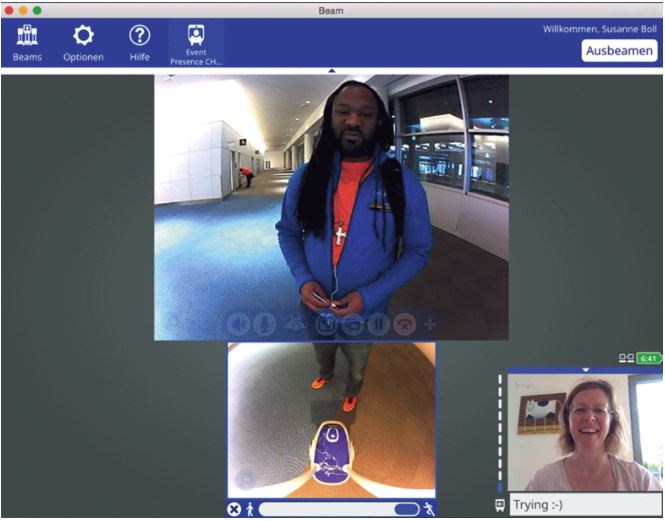
The Good
The BeamPro robot can be personalized.
“Before the conference, we were invited to send a scarf or something to personalize our robot. I chose a pink tutu—part of a carnival costume for my daughter—and gave it to some team members who were traveling to CHI. It turns out that the tutu was a good choice for getting attention, being easily recognized, and starting small talk,” said Boll.
Interaction with participants was relatively comfortable.
“For the most part, I felt connected, and it worked pretty well. The height of the camera and the display of my robot felt good for a conference in which most of the face-to-face conversation was done while standing,” Boll added.
The cost was affordable.
“The actual price for the day was the same as the early-bird one day registration for the conference. Given the technical effort for the installation of the telepresence robots and all the effort by the student volunteers, the price was probably rather cheap,” wrote Boll.
The Bad
It was difficult to find her way around.
“Because the telepresence was set up in a large conference center, there was no indoor map service provided with the robot system, and the different corridors looked almost identical,” said Boll.
Upon finding her room, it was difficult to get around in it.
“As a robot, I always felt as though I were in the way, and the downward-pointing camera confirmed this. There were lots of feet and bags in my way, which people had to move to give me space,” wrote Boll.
The audio left a lot to be desired.
“The room had a microphone and speakers, but it was demanding to listen to the talk and understand everything that was said. In the future, a plug-in mechanism might help,” Boll suggested.
The Ugly
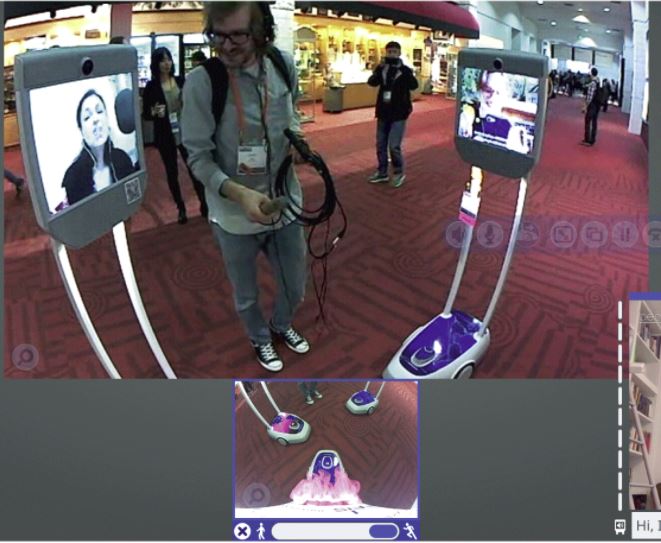
She felt disregarded.
“There were also times when I felt like a second-class participant. In one room, a student volunteer moved me slightly so that another participant could see better,” said Boll.
She felt stuck.
“When I was driving through the hallways during breaks, when it was very crowded, many people walked in my way to quickly bypass me instead of letting me pass,” Boll added.
Elevators were a problem.
“I had to ask someone to accompany me on my way up or down so I could reconnect and return to “life,’” wrote Boll.
So, what was Boll’s final impression?
“For me, this experience was extremely exciting, and it gave me the opportunity to not only attend the conference but also learn a great deal about the state of the art in telepresence.”
Related research on telepresence technology in the Computer Society digital library:
- Immersive Telepresence
- Real Telepresence
- Immersive 3D Telepresence
- Beaming: An Asymmetric Telepresence System
- Antarctic Undersea Exploration Using a Robotic Submarine with a Telepresence User Interface
- Telexistence: Enabling Humans to Be Virtually Ubiquitous

About Lori Cameron
Lori Cameron is a Senior Writer for the IEEE Computer Society and currently writes regular features for Computer magazine, Computing Edge, and the Computing Now and Magazine Roundup websites. Contact her at l.cameron@computer.org. Follow her on LinkedIn.


