Disinformatics: A Passionate Call for More than a New Social Buzzword. Make it a New Academic Discipline to Study Deception.
By Lori Cameron

Jonathan Swift wrote, “Falsehood flies, and the truth comes limping after it.” Nowhere is this more evident than on social media platforms that proliferate fake news, lies, and hoaxes.
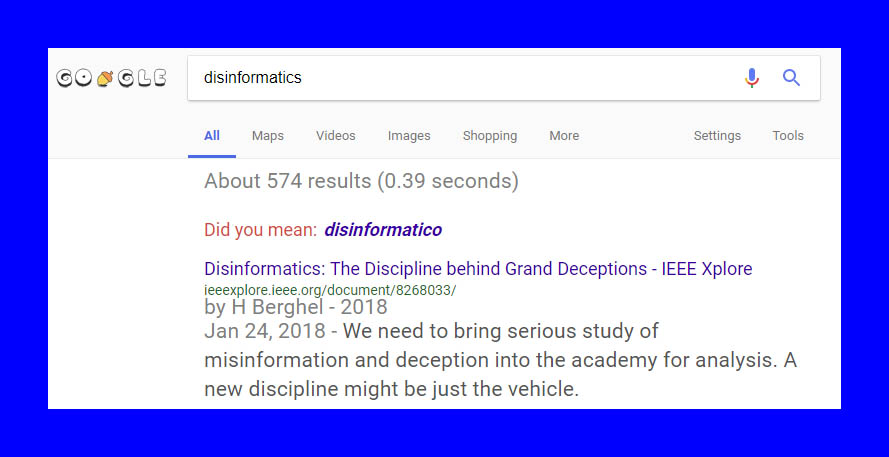
In light of this new misinformation age, scientist Hal Berghel believes a new discipline should be created in academia to further study and analyze deception. He even coined a new word for the field: “Disinformatics.”
It's not even in the dictionary—yet.
What is disinformatics
Berghel, a professor of computer science at the University of Nevada, Las Vegas, offers this definition:
"Simply put, disinformatics is the study of misinformation, broadly defined, and its use (or, if you prefer, information, broadly defined, and its misuse)."
“Disinformatics reveals itself at the intersection of technology, propaganda, and miscreants. It’s the glue that holds together modern faux news outlets, AM talk radio, Twitterstorms, and sundry other sorts of sociopolitical babble. It’s ideologically grounded in postmodern logic and epistemology (for example, truth is what makes the public strong in body and spirit) and rests upon a foundation of informal logical fallacies and falsehoods,” writes Berghel in his article "Disinformatics: The Discipline behind Grand Deceptions" in the January 2018 issue of Computer.
Berghel argues that disinformatics qualifies as a discipline because “disciplines are defined by four hallmarks: a durable domain of human concerns; a codified body of principles (domain knowledge); a codified body of practices; and standards for competence, ethics, and practice.”
Disinformatics: 'Very serious'
Listen to AM talk radio for any length of time, and you’ll find plenty of self-avowed dispensers of truth who are only looking out for the best interests of a devoted audience.
Says Berghel, “The continuous outpouring of fanaticism betrays religious-like zealotry—a conviction that humanity is headed in the wrong direction and that only a select few of their peers can provide the remedy. And make no mistake about this—they’re very serious about their work.”
What is unknowledge

Berghel thinks Lewis Carroll might have called his disinformatics unknowledge. And its realm is deep and wide.
“Unknowledge includes fake news, alt-facts, post-truths, partisan politics, antiscience, garden-variety distortions, leaps of faith, and various linguistic and rhetorical devices that support the galvanization and cohesion of opinion: lies, intentional deceptions, convenient slips of the tongue, malapropisms, antihistorical narratives, and, of course, the age-old staple of despots and tyrants, BS,” Berghel writes.
Signs of eroding government
Berghel references a list of warning signs for democratic erosion proposed by political scientist Jeff Colgan:
- Media intimidation and restrictions
- Identification of crises or political paralysis to justify emergency measures
- Attacks on minorities; scapegoating foreigners
- Closing of space for civil society (through funding restrictions, legal cases, raids and arrests, and so on)
- Rhetorical rejection of the current political system; discourse shift
- Expanding the size of courts or other bodies to stack it with partisan judges/officials
- Modifying rules to impose or eliminate term limits on officials, especially election officials
- Weakening of legislatures/intimidation of legislators
- Silencing of political opposition
- Significant increase in internal security forces
Standards for Competence, Ethics, and Practice
Berghel seeks ethics to combat the lies.
He calls the practitioners of this new dark art "disinformaticians."
“Disinformaticians gauge their competence by winning elections, crushing political opponents, defaming and delegitimizing adversaries, distracting the public from real issues, getting people fired, ruining businesses that oppose their interests—the list is endless,” he writes.
However, Berghel notes that the ethics of social and political manipulation are troubling, as illustrated by Austrian-American pioneer in public relations and propaganda, Edward Bernays, and his campaign to get women to smoke by calling cigarettes “torches of freedom,” and American political consultant, Frank Luntz, and his arousal of public ire against estate taxes by calling them “death taxes.” Still, he admits, the evidence is there of a world view that, however warped, disinformaticians must defend.
So, how would we benefit from the study of disinformatics? For one, Berghel believes it would explain political anomalies and unexpected election outcomes. “Based on the recent US presidential election, despite the minimal density with respect to the totality of campaign coverage, it seemed to have a dominating influence. Disinformation has become a pervasive, unquantifiable force that dominates much of politics,” he writes.
Second, it explains the existence of misinformation clumps in our vast body of collective knowledge.
“Fake news by definition doesn’t cohere with collective knowledge—it is, after all, fake. So when the birthers, Pizzagaters, and Bowling Green massacre merchants pollute the web, blogosphere, or Wayback Machine servers with lies, distortions, and sundry other misinformation, they’re necessarily introducing data clumps into the digital broth—clumps that can never mix well with other information because they are inconsistent with it,” Berghel says.
More articles by Hal Berghel in the Computer Society Digital Library
Login may be required for full text.
- Oh, What a Tangled Web: Russian Hacking, Fake News, and the 2016 US Presidential Election
- Software Sophistry and Political Sleight of Hand
- The New Science Wars
- A Farewell to Air Gaps, Part 1
- A Farewell to Air Gaps, Part 2

About Lori Cameron
Lori Cameron is a Senior Writer for the IEEE Computer Society and currently writes regular features for Computer magazine, Computing Edge, and the Computing Now and Magazine Roundup websites. Contact her at l.cameron@computer.org. Follow her on LinkedIn.


