Supercomputing Revisits Einstein’s Theory
By Lori Cameron
By Lori Cameron on

For a long time, Albert Einstein's theory of relativity has been challenged by singularity theories related to black holes and the "Big Bang" theory.
It's a world-reknown scientist's worst nightmare.
But researchers believe that supercomputers are about to change all that.
While Einstein's famous equation E = MC2 accounts for a lot of powerful forces like gravity, solar power, and nuclear energy, it can't explain singularities—the point at which things become infinitely big or small—like black holes (small) and the Big Bang (big).
When it comes to classical space-time, the laws of quantum physics just don't apply. Now, thanks to supercomputers, researchers might be able to reconcile the inconsistencies.
"Using supercomputers, explorations of the very genesis of space and time from quantum geometry are revealing a novel picture of what lies beyond classical singularities and the new physics of the birth of our universe," says Parampreet Singh of Louisiana State University in his article "Glimpses of Space-Time Beyond the Singularities Using Supercomputers."
Researchers are attempting to merge the theory of classical relativity with quantum theory into a brand new theory that solves the mystery of quantum space-time, black holes, and the Big Bang.
"One of the main candidate theories of quantum gravity is loop quantum gravity (LQG). Unlike other approaches to quantum gravity, it is nonperturbative and background independent. In simple words, it means that LQG treats gravity as dynamics of space-time in the true spirit of Einsteinian gravity, not just as another force on a spectator space-time, which is a central theme of Newtonian gravity and other fundamental forces," says Singh.
How the "Chimera" method can lighten the load
Singh suggests using the Chimera method—a hybrid approach to numerical loop quantum cosmology—because it will ease the computational workload.
"The Chimera algorithm reduces the computational cost for numerical simulations on quantum geometry by using some of the key properties of the quantum Hamiltonian obtained for isotropic and anisotropic space-times in LQG," he says.
So, was the Big Bang a "bang" or a "bounce"? Based on the Chimera method application sample below, it would appear the latter.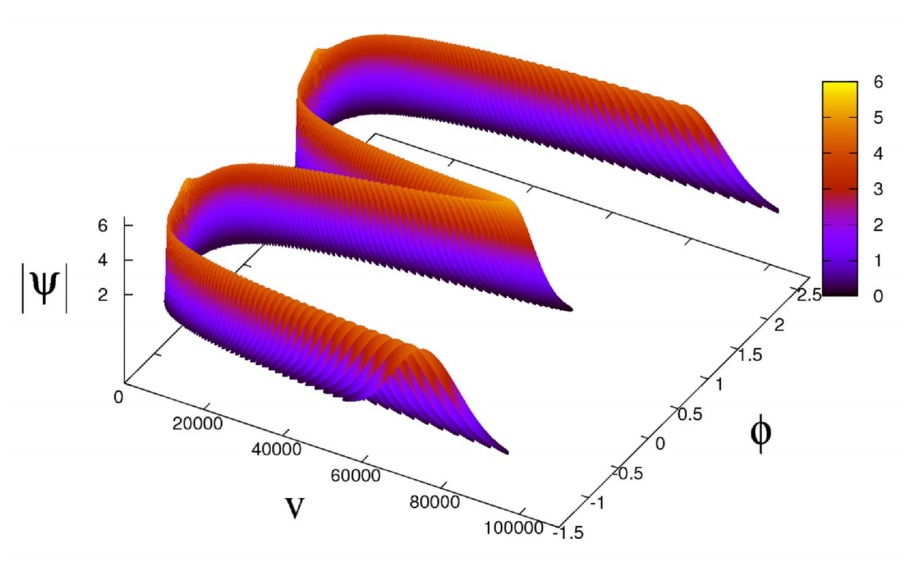
The magnitude of the wavefunction of the universe is plotted versus the volume of the isotropic universe, with the scalar field playing the role of time.
"The big bang and big crunch are avoided in the quantum theory, as the plot demonstrates. This figure corresponds to the case of a cyclic universe that classically encounters the big bang singularity in the past and the big crunch singularity in the future. Only a snapshot of the evolution of the state in a region near the classical singularity is shown," Singh says.
Bouncing in anisotropic space-time
The plot below shows the "bounce" of a quantum state initially peaked at the classical trajectory (upper solid black curve) in logarithmic variables in two directions of the Bianchi-I space-time. As in the previous illustration, only the region close to singularity is shown.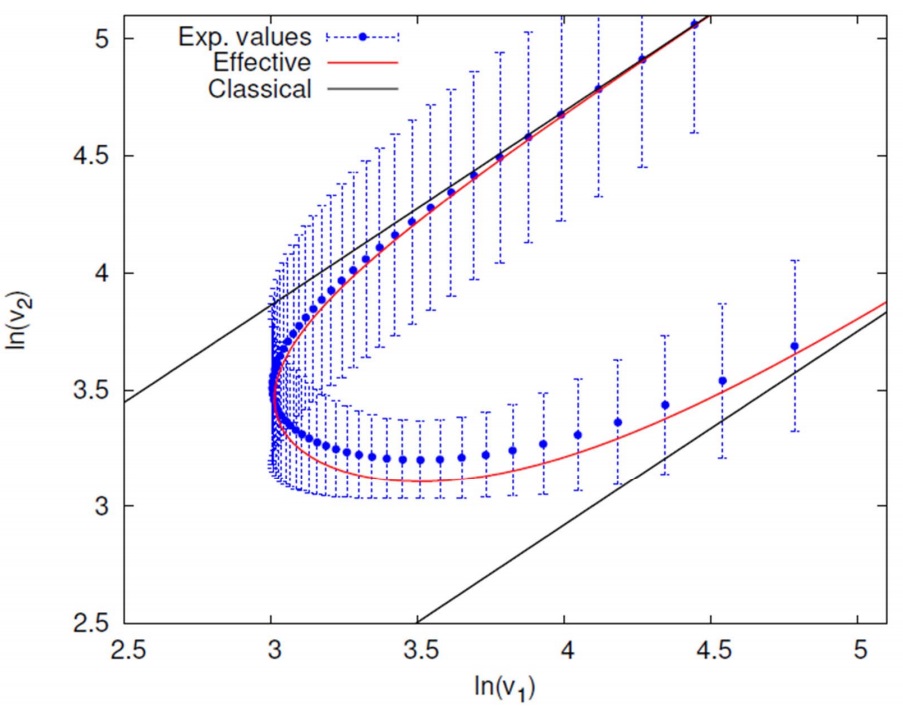
The classical curves are singular and disconnected. Quantum gravity effects cause a bounce of the state from one curve to the other. The quantum expectation values, shown by black dots, and corresponding dispersions are captured extremely well by an effective space-time trajectory marked in red.
The validity of the effective space-time description
The relative difference in the expectation value of ln(v2) at the bounce and the value predicted by the effective theory are plotted for various simulations in the graph below.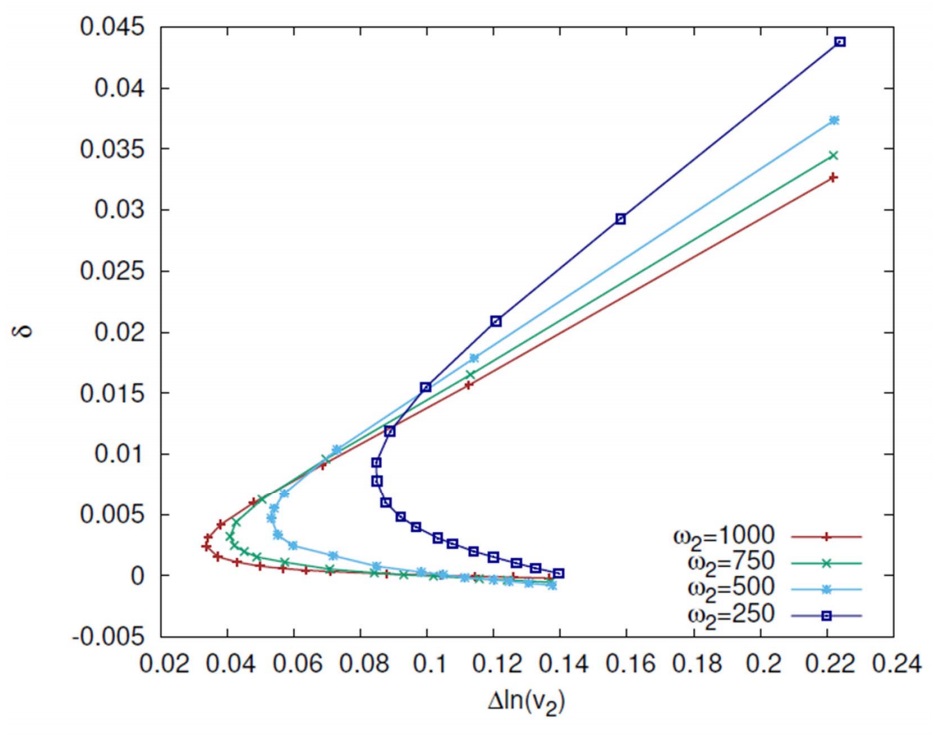
The difference between quantum theory and effective theory decreases as the spread in the state decreases only up to a certain value. The lowest values of 2 are found for larger spreads. Each dot corresponds to one numerical simulation with at least 1016 flops—a whopping ten quadrillion calculations.
What the future holds
Understanding the properties of quantum space-time is extremely difficult. The theory must be deciphered even in the absence of observational data, says Singh.
However, researchers have made significant strides in understanding quantization in loop quantum gravity over the last three decades. As a result, "interesting cosmological and black hole space-times can be loop-quantized and singularity resolution can be studied," says Singh.
"In general relativity, singularities are the final boundaries at which evolution stops and all known laws of physics break down. The hope has been that a quantum theory of gravity will eliminate these boundaries, extending the space-time beyond the big bang," Singh says.
Research related to quantum computing in the Computer Society Digital Library:
- A Microarchitecture for a Superconducting Quantum Processor
- Quantum Imagination
- The Quantum Future of Computation
- The Path to Scalable Distributed Quantum Computing
- A Future with Quantum Machine Learning
- Post-Quantum Cryptography: What Advancements in Quantum Computing Mean for IT Professionals
- A Quantum-Inspired Feature Fusion Method Based on Maximum Fidelity
- Quantum Molecular Dynamics in the Post-Petaflops Era
- Cryptography Standards in Quantum Time: New Wine in an Old Wineskin?

About Lori Cameron
Lori Cameron is a Senior Writer for the IEEE Computer Society and currently writes regular features for Computer magazine, Computing Edge, and the Computing Now and Magazine Roundup websites. Contact her at l.cameron@computer.org. Follow her on LinkedIn.


