• IEEE.org
  • IEEE CS Standards
  • Career Center
  • About Us
  • Subscribe to Newsletter

0

IEEE
CS Logo
  • MEMBERSHIP
  • CONFERENCES
  • PUBLICATIONS
  • EDUCATION & CAREER
  • VOLUNTEER
  • ABOUT
  • Join Us
CS Logo

0

IEEE Computer Society Logo
Sign up for our newsletter
FacebookTwitterLinkedInInstagramYoutube
IEEE COMPUTER SOCIETY
About UsBoard of GovernorsNewslettersPress RoomIEEE Support CenterContact Us
COMPUTING RESOURCES
Career CenterCourses & CertificationsWebinarsPodcastsTech NewsMembership
BUSINESS SOLUTIONS
Corporate PartnershipsConference Sponsorships & ExhibitsAdvertisingRecruitingDigital Library Institutional Subscriptions
DIGITAL LIBRARY
MagazinesJournalsConference ProceedingsVideo LibraryLibrarian Resources
COMMUNITY RESOURCES
GovernanceConference OrganizersAuthorsChaptersCommunities
POLICIES
PrivacyAccessibility StatementIEEE Nondiscrimination PolicyIEEE Ethics ReportingXML Sitemap

Copyright 2025 IEEE - All rights reserved. A public charity, IEEE is the world’s largest technical professional organization dedicated to advancing technology for the benefit of humanity.

  • Home
  • /Publications
  • /Tech News
  • /Research
  • Home
  • / ...
  • /Tech News
  • /Research

Augmented Reality: Are the Glasses that Make Everything Else Look Good Making You Look Weird?

By Lori Cameron

By Lori Cameron on
October 16, 2017

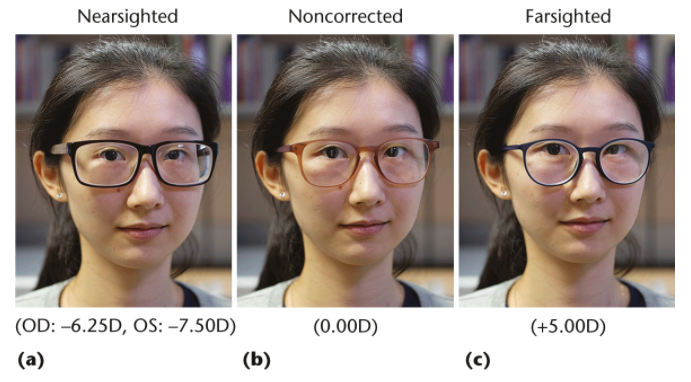
While eyeglasses have improved the lives of millions of people, many wearers are painfully aware of how weird glasses can make their eyes look. The eyes of near-sighted wearers appear smaller through the lens, while the eyes of far-sighted wearers appear larger.
eyeglasses1eyeglasses1
Prescription eyeglasses introduce refraction effects that change the wearer’s appearance. The eyes of a person wearing corrective lenses for nearsightedness (a) will appear smaller compared with (b) wearing nonprescription lenses, whereas the eyes of a person wearing lenses for farsightedness (c) will appear larger.

The problem is “the traditional process of trying on and picking new eyeglasses in a brick-and-mortar shop has a significant shortcoming: eyeglasses on the display are equipped with demo lenses that have zero corrective power, and thus refraction does not deform the eyes,” write Qian Zhang of Nanyang Technological University in Singapore and other researchers in “A Virtual Try-On System for Prescription Eyeglasses,” published in the July/August 2017 issue of IEEE Computer Graphics & Applications.

Zhang and her team have developed a system to give users a more realistic experience, a virtual try-on system for prescription eyeglasses modifies an input video and virtually inserts prescription eyeglasses, producing an output similar to a virtual mirror.

Read research on augmented reality for eyeglasses here (login required for full text)

The proposed system generates a 3D representation of the corrective lenses mounted into the eyeglasses frame, giving wearers an accurate picture of how the glasses make them look.

Better than other virtual try-on systems, this approach simulates the refraction effects due to the corrective lens and takes into account reflections and shading, allowing wearers to make more informed purchasing decisions.

The other writers of the research are Yu Guois of University of California, Irvine; Pierre-Yves Laffontis of Lemnis Technologies; Tobias Martinis of VirtaMed; and Markus Grossis of ETH Zurich.

Research related to vision, visual analytics, and eye health in the Computer Society Digital Library

Login may be required for full text.

  • Third Eye: A Shopping Assistant for the Visually Impaired
  • Driver Gaze Region Estimation without Use of Eye Movement
  • Forget the Funny Glasses
  • Tracking Developers' Eyes in the IDE
  • Eye-Controlled Interfaces for Multimedia Interaction
  • Eye Tracking in Computer-Based Visualization
  • Eye Tracking for Personal Visual Analytics


About Lori Cameron

Lori Cameron is a Senior Writer for the IEEE Computer Society and currently writes regular features for Computer magazine, Computing Edge, and the Computing Now and Magazine Roundup websites. Contact her at l.cameron@computer.org. Follow her on LinkedIn.

LATEST NEWS
The Cybersecurity & AI Junior School Workshop: Bridging the Digital Skills Gap for Future Innovators
Supply Chain Concepts in Health Information Management: Strategic Integration and Information Flow Optimization
The Road Ahead: Preparing for 2030’s Digital Oil & Gas
Celebrating Innovation at TechX Florida 2025
Quantum Insider Session Series: Practical Instructions for Building Your Organization’s Quantum Team
Read Next

The Cybersecurity & AI Junior School Workshop: Bridging the Digital Skills Gap for Future Innovators

Supply Chain Concepts in Health Information Management: Strategic Integration and Information Flow Optimization

The Road Ahead: Preparing for 2030’s Digital Oil & Gas

Celebrating Innovation at TechX Florida 2025

Quantum Insider Session Series: Practical Instructions for Building Your Organization’s Quantum Team

Beyond Benchmarks: How Ecosystems Now Define Leading LLM Families

From Legacy to Cloud-Native: Engineering for Reliability at Scale

Announcing the Recipients of Computing's Top 30 Early Career Professionals for 2025

Get the latest news and technology trends for computing professionals with ComputingEdge
Sign up for our newsletter