• IEEE.org
  • IEEE CS Standards
  • Career Center
  • About Us
  • Subscribe to Newsletter

0

IEEE
CS Logo
  • MEMBERSHIP
  • CONFERENCES
  • PUBLICATIONS
  • EDUCATION & CAREER
  • VOLUNTEER
  • ABOUT
  • Join Us
CS Logo

0

IEEE Computer Society Logo
Sign up for our newsletter
IEEE COMPUTER SOCIETY
About UsBoard of GovernorsNewslettersPress RoomIEEE Support CenterContact Us
COMPUTING RESOURCES
Career CenterCourses & CertificationsWebinarsPodcastsTech NewsMembership
BUSINESS SOLUTIONS
Corporate PartnershipsConference Sponsorships & ExhibitsAdvertisingRecruitingDigital Library Institutional Subscriptions
DIGITAL LIBRARY
MagazinesJournalsConference ProceedingsVideo LibraryLibrarian Resources
COMMUNITY RESOURCES
GovernanceConference OrganizersAuthorsChaptersCommunities
POLICIES
PrivacyAccessibility StatementIEEE Nondiscrimination PolicyIEEE Ethics ReportingXML Sitemap

Copyright 2025 IEEE - All rights reserved. A public charity, IEEE is the world’s largest technical professional organization dedicated to advancing technology for the benefit of humanity.

FacebookTwitterLinkedInInstagramYoutube
  • Home
  • /Publications
  • /Tech News
  • /Research
  • Home
  • / ...
  • /Tech News
  • /Research

Genuine or Impostor: How Researchers Are Improving the Accuracy of Biometrics Systems Using Ensembles

By Lori Cameron

By Lori Cameron on
September 12, 2018

Featured ImageFeatured ImageBiometrics systems that use facial recognition, iris scans, voice recognition, and fingerprints are used all the time by banks, law enforcement, and employers.

Biometrics also give you a convenient and somewhat fail-safe way to log in to your electronic devices.

Now that more and more people are doing financial transactions and storing personal data online, service providers are looking at biometrics systems to improve security. However, recent studies show that biometric features can change over time—an effect called "template aging."

Adaptive biometric systems that use query samples classified as "genuine" have been proposed to deal with this problem. However, despite some good results, researchers are concerned about their robustness.

That's why a group of computer scientists from the University of São Paulo propose the use of a stacking ensemble to improve the way biometric systems classify certain traits.

Stacking ensembles combine several different algorithms that run on the same set of data increasing the precision of a biometric match.

"Several adaptive biometric systems have been proposed for one-class algorithms. Some are better at reducing false match, while others are better at reducing false non-matches. Combining individual techniques into ensembles can produce more accurate and stable decision models," say the authors of "Adaptive Biometric Systems Using Ensembles." (login may be required for full text)
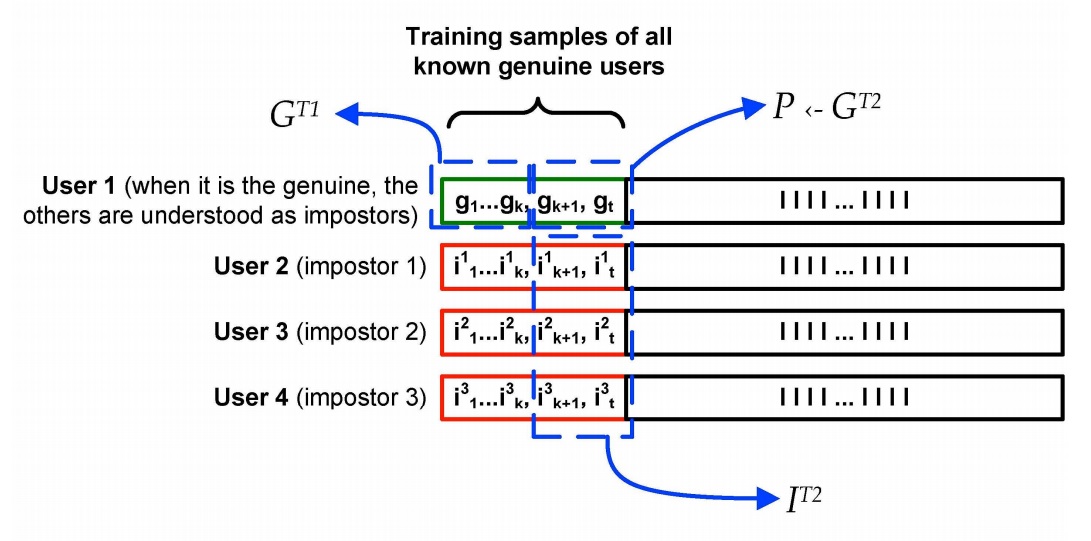
Division of samples used for trainingDivision of samples used for training
Division of samples used for training. The system includes one genuine user and three impostors.

Ensembles teach biometrics systems how to better identify you.

They can improve the recognition performance of decision models, providing a more stable classification decision that will increase accuracy and security.

The authors—Paulo Henrique Pisani, Ana Carolina Lorena, and André C.P.L.F. de Carvalho—explore questions regarding the application of ensembles to adaptive biometric systems using one-class classification algorithms that will automatically adapt the meta classifier over time.

Research related to biometrics in the Computer Society Digital Library

Login may be required for full text.

  • Experiments with Ocular Biometric Datasets: A Practitioner’s Guideline
  • Situational Awareness through Biometrics
  • Continuous Authentication Using Behavioral Biometrics
  • Biometrics in Identity Management Systems
  • What Are Soft Biometrics and How Can They Be Used?
  • Biometrics and the Threat to Civil Liberties


About Lori Cameron

Lori Cameron is a Senior Writer for the IEEE Computer Society and currently writes regular features for Computer magazine, Computing Edge, and the Computing Now and Magazine Roundup websites. Contact her at l.cameron@computer.org. Follow her on LinkedIn.

LATEST NEWS
From Isolation to Innovation: Establishing a Computer Training Center to Empower Hinterland Communities
IEEE Uganda Section: Tackling Climate Change and Food Security Through AI and IoT
Blockchain Service Capability Evaluation (IEEE Std 3230.03-2025)
Autonomous Observability: AI Agents That Debug AI
Disaggregating LLM Infrastructure: Solving the Hidden Bottleneck in AI Inference
Read Next

From Isolation to Innovation: Establishing a Computer Training Center to Empower Hinterland Communities

IEEE Uganda Section: Tackling Climate Change and Food Security Through AI and IoT

Blockchain Service Capability Evaluation (IEEE Std 3230.03-2025)

Autonomous Observability: AI Agents That Debug AI

Disaggregating LLM Infrastructure: Solving the Hidden Bottleneck in AI Inference

Copilot Ergonomics: UI Patterns that Reduce Cognitive Load

The Myth of AI Neutrality in Search Algorithms

Gen AI and LLMs: Rebuilding Trust in a Synthetic Information Age

Get the latest news and technology trends for computing professionals with ComputingEdge
Sign up for our newsletter