Bridging the Digital Divide: How to Connect Marginalized Communities Around the World
By Lori Cameron
 An ambitious proposal to end the digital isolation of those in the developing world calls upon tech and government leaders to create sweeping reforms that ensure access to information is a human right.
It would be all possible under a new "regime of internationally coordinated technology policy," says Carleen F. Maitland, associate professor in the College of Information Sciences and Technology at Pennsylvania State University.
The mission seeks "computing for all," especially in the remotest corners of the globe, from refugees fleeing war-torn areas to Native Americans residing on sovereign lands in the United States.
Advocating a Human Rights-Based Approach
Funded by U.S. National Science Foundation grants, Maitland's proposal envisions a partnership between governments and non-profit groups whose aim is to provide marginalized communities with flexible and easily-deployed technologies that keep them connected to the rest of the world.
This connection, says Maitland, would give them access to adequate relief assistance, healthcare, and social services. The proposal asserts a human rights-based approach that will allow the digitally disenfranchised to participate socially and politically in the world.
"A rights-based approach also supports more consistent sources of funding for connecting marginalized communities. Such large-scale change is needed to overcome the fragmented and program-oriented approach to funding connectivity," Maitland writes.
Uncertainty of Cost for the Ambitious Program
How much will it cost? No one really knows.
But Maitland’s case studies in diverse contexts bear out the extent of the problem.
- In the United States, American Indian and Alaskan Native communities suffer a staggering 85 percent lack of modern broadband.
- In other parts of the world, Syrian refugees in Jordan are denied internet access because of “security concerns” while Congolese refugees in Rwanda, especially women, struggle to obtain food from assistance programs that do business online.
Chart Illustrates Technical, Organizational, and Policy Solutions
To solve these types of problems, Maitland proposes providing consistent network access to marginalized communities through technical, organizational, and policy measures:
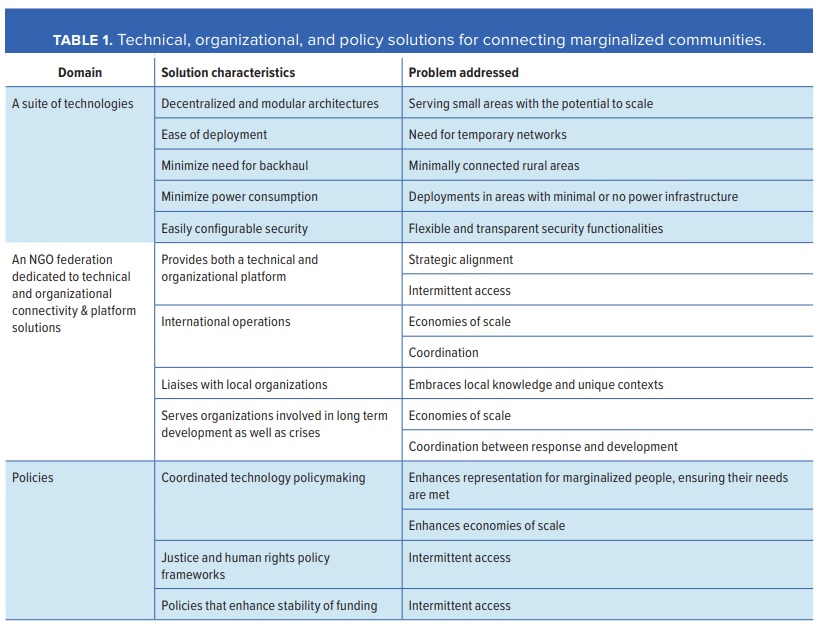
Maitland’s solution uses a suite of flexible, energy-efficient technologies. It also relies on widespread cooperation among non-governmental relief organizations and the involvement of governments whose policies give citizens the right to digital information and free expression.
She emphasizes the importance of all three elements working in concert.
Join the IEEE Computer Society today.
“A single policy, organizational design, or technology cannot, alone, solve the complex challenges of connecting marginalized communities, Maitland says. “However, a more holistic approach, incorporating all three dimensions, is likely to bring about more scalable and lasting solutions.”
Maitland believes policymakers play a key role in shaping technologies as well as providing stable and sufficient funding for these measures.
Read more in “Now You See It, Now You Don’t: Digital Connectivity in Marginalized Communities.”


