• IEEE.org
  • IEEE CS Standards
  • Career Center
  • About Us
  • Subscribe to Newsletter

0

IEEE
CS Logo
  • MEMBERSHIP
  • CONFERENCES
  • PUBLICATIONS
  • EDUCATION & CAREER
  • VOLUNTEER
  • ABOUT
  • Join Us
CS Logo

0

IEEE Computer Society Logo
Sign up for our newsletter
IEEE COMPUTER SOCIETY
About UsBoard of GovernorsNewslettersPress RoomIEEE Support CenterContact Us
COMPUTING RESOURCES
Career CenterCourses & CertificationsWebinarsPodcastsTech NewsMembership
BUSINESS SOLUTIONS
Corporate PartnershipsConference Sponsorships & ExhibitsAdvertisingRecruitingDigital Library Institutional Subscriptions
DIGITAL LIBRARY
MagazinesJournalsConference ProceedingsVideo LibraryLibrarian Resources
COMMUNITY RESOURCES
GovernanceConference OrganizersAuthorsChaptersCommunities
POLICIES
PrivacyAccessibility StatementIEEE Nondiscrimination PolicyIEEE Ethics ReportingXML Sitemap

Copyright 2025 IEEE - All rights reserved. A public charity, IEEE is the world’s largest technical professional organization dedicated to advancing technology for the benefit of humanity.

  • Home
  • /Publications
  • /Tech News
  • /Research
  • Home
  • / ...
  • /Tech News
  • /Research

Sally Weber and Holographic Light: Art in a State of Constant Flux

By Lori Cameron

By Lori Cameron on
August 6, 2018
Featured ImageFeatured ImageWhile some artists prefer oils or acrylics, the medium of choice for Sally Weber is light—holography and laser traces, that is. Years ago, as a graduate student at the Center for Advanced Visual Studies at MIT, she studied under Otto Piene, a German artist specializing in kinetic and technology-based art. During those years, she produced several solar installations through the facilities of the Regional Laser Center in the George R. Harrison Spectroscopy Laboratory. "Her iterative process includes exploring tangible materials to find an art piece composition that can transfix an audience—an experiential state of being that results in lingering long enough to appreciate the art while wondering about the underlying communication," say adjunct faculty member Bruce Campbell of the Rhode Island School of Design and researcher Francesca Samsel of the University of Texas–Austin. Campbell and Samsel caught up with Weber after seeing her latest work, InFLUX, at her exhibit, ELEMENTAL, a current installation at the Butler Institute of American Art, in Youngstown, OH. "As an artist who has worked with light as her medium for a distinguished career, we believe Sally has much of value to share with our readership," they say in their profile "Sally Weber: Making Art from Light" in the May/June 2018 issue of IEEE Computer Graphics and Applications.

Sally Weber discusses her work, ELEMENTAL.

Outdoor art: Weber creates sun arcs and water fountains with holographic optics

The first two images depict some of Weber's earlier work, LightScape and FocalPoint, in which she uses holographic optical elements.
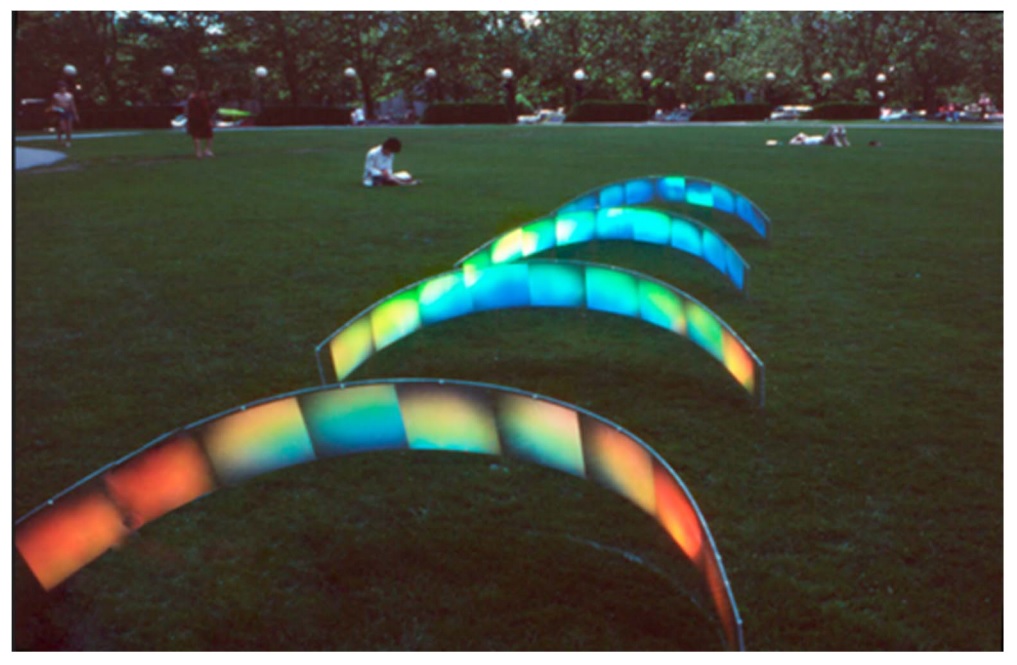
LightScape is a solar installation using holographic optical elements and acrylicLightScape is a solar installation using holographic optical elements and acrylic
Photo credit: Sally Weber. (Used with permission.)
LightScape is a solar installation using holographic optical elements and acrylic. Sited on Kresge Lawn of  the Massachusetts Institute of Technology, the sculpture is designed to reflect the sun’s arc across the site and Kresge Auditorium’s curved roof. The holographic elements float above the ground and alter in color with the sun’s angle and the viewer’s distance from the installation.
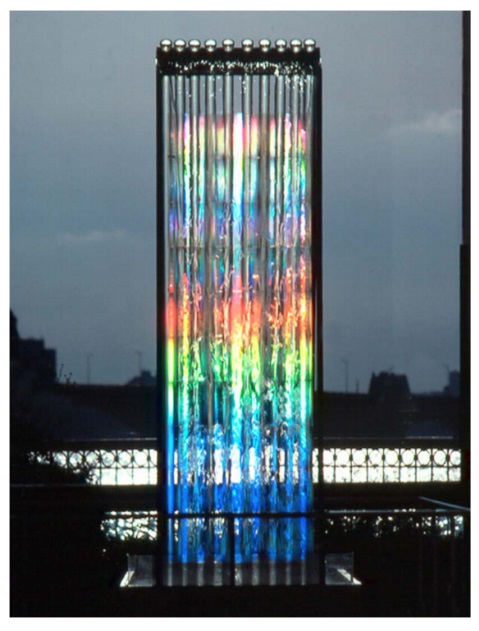
FocalPoint is a solar water fountainFocalPoint is a solar water fountain
Photo credit: Sally Weber. (Used with permission.)
FocalPoint is a solar water fountain with holographic optical elements, glass pipes, steel, and a water system. Designed to focus sunlight into three lines of light that scan across the floor and walls in response to the sun’s motion, the fountain is installed at the Boston Museum of Science overlooking the Charles River in Boston.

A laser pendulum called InFLUX

Below are two representations of InFlux, part of Weber's recent solo exhibit, Elemental.

InFlux, the laser pendulum installation, suggests an experience of being elementally interconnected, says Sally Weber.

Laser pendulums draw in the sand leaving a trace of their path as color patterns building up over time. InFLUX is a two-part laser pendulum installation in Elemental, at the Butler Institute of American Art in Youngstown, Ohio.
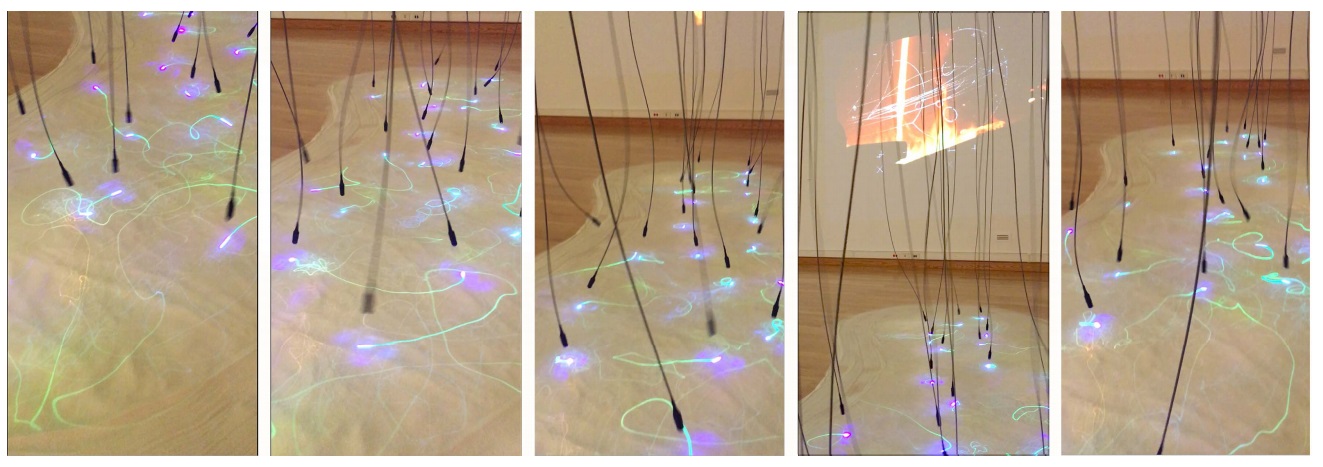
 A series of stills from inFLUX at the Butler Institute of American Art A series of stills from inFLUX at the Butler Institute of American Art
Photo credit: Sally Weber. (Used with permission.)
Above is a series of stills from InFLUX. Over time, patterns emerge and fade to be redrawn as the pendulums interact, collide, twist and pass by each other.

Aiming for a 'sense of wonder'

Weber describes the laser traces as a fundamental element of InFLUX that catches you in a moment of silence, neither thinking nor feeling, just transfixed. “As an artist, occasionally, I hope to catch someone before words. In that place there is experience. I aim for that ongoing sense of wonder when one has to stop long enough to see and feel," says Weber.
About Lori Cameron Lori Cameron is a Senior Writer for the IEEE Computer Society and currently writes regular features for Computer magazine, Computing Edge, and the Computing Now and Magazine Roundup websites. Contact her at l.cameron@computer.org. Follow her on LinkedIn.
LATEST NEWS
Reimagining Infrastructure and Systems for Scientific Discovery and AI Collaboration
IEEE 2881: Learning Metadata Terms (LMT) Empowers Learning in the AI Age
Platform Engineering: Bridging the Developer Experience Gap in Enterprise Software Development
IEEE Std 3158.1-2025 — Verifying Trust in Data Sharing: Standard for Testing and Performance of a Trusted Data Matrix System
IEEE Std 3220.01-2025: Standard for Consensus Framework for Blockchain System
Read Next

Reimagining Infrastructure and Systems for Scientific Discovery and AI Collaboration

IEEE 2881: Learning Metadata Terms (LMT) Empowers Learning in the AI Age

Platform Engineering: Bridging the Developer Experience Gap in Enterprise Software Development

IEEE Std 3158.1-2025 — Verifying Trust in Data Sharing: Standard for Testing and Performance of a Trusted Data Matrix System

IEEE Std 3220.01-2025: Standard for Consensus Framework for Blockchain System

Mapping the $85B AI Processor Landscape: Global Startup Surge, Market Consolidation Coming?

AI Agentic Mesh – A Foundational Architecture for Enterprise Autonomy

IEEE O.C A.I “DEVHACK” Hackathon 2025 Winner Celebration

FacebookTwitterLinkedInInstagramYoutube
Get the latest news and technology trends for computing professionals with ComputingEdge
Sign up for our newsletter