• IEEE.org
  • IEEE CS Standards
  • Career Center
  • About Us
  • Subscribe to Newsletter

0

IEEE
CS Logo
  • MEMBERSHIP
  • CONFERENCES
  • PUBLICATIONS
  • EDUCATION & CAREER
  • VOLUNTEER
  • ABOUT
  • Join Us
CS Logo

0

IEEE Computer Society Logo
Sign up for our newsletter
IEEE COMPUTER SOCIETY
About UsBoard of GovernorsNewslettersPress RoomIEEE Support CenterContact Us
COMPUTING RESOURCES
Career CenterCourses & CertificationsWebinarsPodcastsTech NewsMembership
BUSINESS SOLUTIONS
Corporate PartnershipsConference Sponsorships & ExhibitsAdvertisingRecruitingDigital Library Institutional Subscriptions
DIGITAL LIBRARY
MagazinesJournalsConference ProceedingsVideo LibraryLibrarian Resources
COMMUNITY RESOURCES
GovernanceConference OrganizersAuthorsChaptersCommunities
POLICIES
PrivacyAccessibility StatementIEEE Nondiscrimination PolicyIEEE Ethics ReportingXML Sitemap

Copyright 2025 IEEE - All rights reserved. A public charity, IEEE is the world’s largest technical professional organization dedicated to advancing technology for the benefit of humanity.

  • Home
  • /Publications
  • /Tech News
  • /Research
  • Home
  • / ...
  • /Tech News
  • /Research

Brains and Brawn: How Cognitive Computing Frameworks Can Help Human Workers Do Better on the Assembly Line

by Lori Cameron

By Lori Cameron on
February 14, 2019

As mass production goes global, industry leaders look to better forms of automation to increase efficiency.

However, many of them are moving back toward a human-centered framework because fully-automated systems are rife with error.

Machines are good at doing repetitive tasks much faster than humans. They are good at the heavy lifting. But sometimes, if assembly parts are not arranged in proper order, turned the wrong way, or missing altogether, the end product must be thrown out—costing the company time and money.

Like what you're reading? Stay ahead of your field and sign up here for our Build Your Career or Computing Edge newsletters to get content like this delivered right to your inbox weekly.

So how can human and machine work together more efficiently?
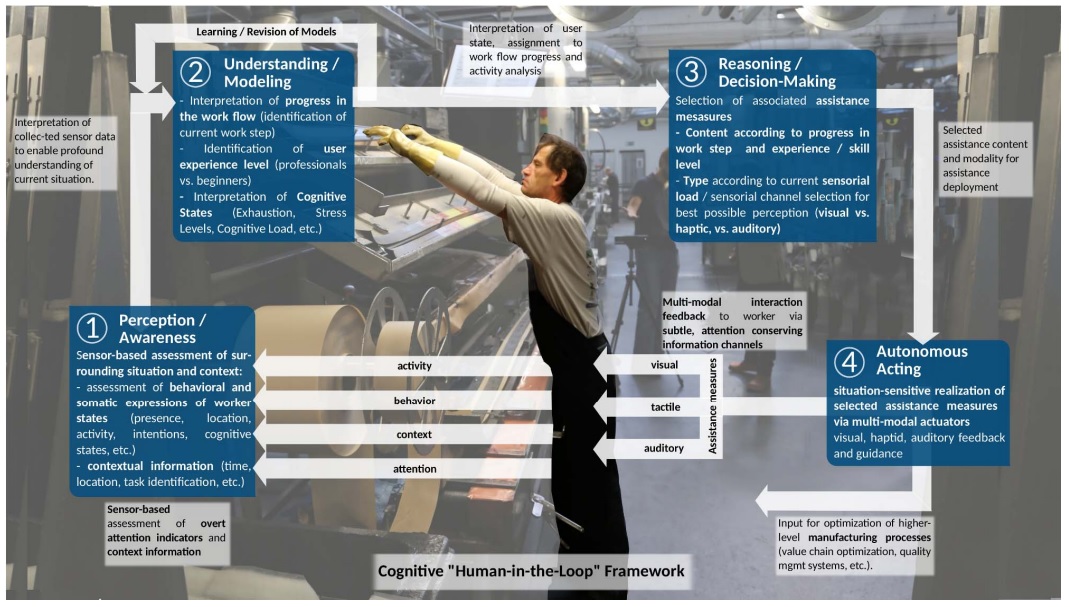
cognitive frameworkcognitive framework
Schematic description of the proposed cognitive framework including the cognitive functions of (1) perception/awareness, (2) understanding and modeling of context, (3) reasoning and decision making, and (4) autonomous execution of assistance measures.

Researchers from Austria have developed a “cognitive assistance” framework for supporting human workers in industrial tasks—in their test case, assembly of an alpine sport product. The system is capable of detecting the steps in the assembly process, tracking the worker’s progress, assessing the mental and physical state of the worker, and determining the worker’s skill level.

With the human in charge, the computer system uses all of this information to provide support and correction if needed.

Read more in “A Cognitive Assistance Framework for Supporting Human Workers in Industrial Tasks.”


About Lori Cameron

Lori Cameron is Senior Writer for IEEE Computer Society publications and digital media platforms with over 20 years extensive technical writing experience. She is a part-time English professor and winner of two 2018 LA Press Club Awards. Contact her at l.cameron@computer.org. Follow her on LinkedIn.

LATEST NEWS
Quantum Insider Session Series: Practical Instructions for Building Your Organization’s Quantum Team
Beyond Benchmarks: How Ecosystems Now Define Leading LLM Families
From Legacy to Cloud-Native: Engineering for Reliability at Scale
Announcing the Recipients of Computing's Top 30 Early Career Professionals for 2025
IEEE Computer Society Announces 2026 Class of Fellows
Read Next

Quantum Insider Session Series: Practical Instructions for Building Your Organization’s Quantum Team

Beyond Benchmarks: How Ecosystems Now Define Leading LLM Families

From Legacy to Cloud-Native: Engineering for Reliability at Scale

Announcing the Recipients of Computing's Top 30 Early Career Professionals for 2025

IEEE Computer Society Announces 2026 Class of Fellows

MicroLED Photonic Interconnects for AI Servers

Vishkin Receives 2026 IEEE Computer Society Charles Babbage Award

Empowering Communities Through Digital Literacy: Impact Across Lebanon

FacebookTwitterLinkedInInstagramYoutube
Get the latest news and technology trends for computing professionals with ComputingEdge
Sign up for our newsletter